

Men don’t talk about this. The tightness, the discomfort during sex, the infections that keep returning, most either push through it silently as well as feel too uncomfortable to bring it up with a doctor.
A surprising number of men dealing with these symptoms have no idea there is a name for what they have, let alone that it can be treated.
The condition is phimosis. And in the majority of cases it responds to treatment, often without any surgery involved, and without the experience being remotely as difficult as men tend to assume it will be.
This guide covers the condition itself, the treatment options available across India in 2026, what each option costs, and how Ayurvedic care fits into the picture alongside conventional approaches.
What Is Phimosis: Symptoms That Show Up in Real Life
What is phimosis when it appears in day-to-day life, it tends to be a cluster of symptoms that individually seem minor but together tell a clear story.
The foreskin will not retract, or barely move before resistance stops it. Erections become uncomfortable because the tight skin cannot stretch with the expansion of the penis. Sex is painful to varying degrees, sometimes enough to affect how often a man is willing to attempt it.
In more advanced cases, the urine stream becomes weak or unpredictably misdirected. Recurring redness, and irritation, along with discharge under the foreskin are common, particularly in men with poor retraction who struggle to clean the area properly.
Where lichen sclerosus is involved, a pale, thickened ring of hardened skin becomes visible around the foreskin tip. What is phimosis meaning at different levels, the condition is graded from one to five. At grade one, the foreskin retracts but is tight doing so.
At grade five, no retraction is possible at all. This grading is not just a classification exercise, it determines whether conservative treatment is appropriate or whether the anatomy makes a more direct intervention necessary from the outset.
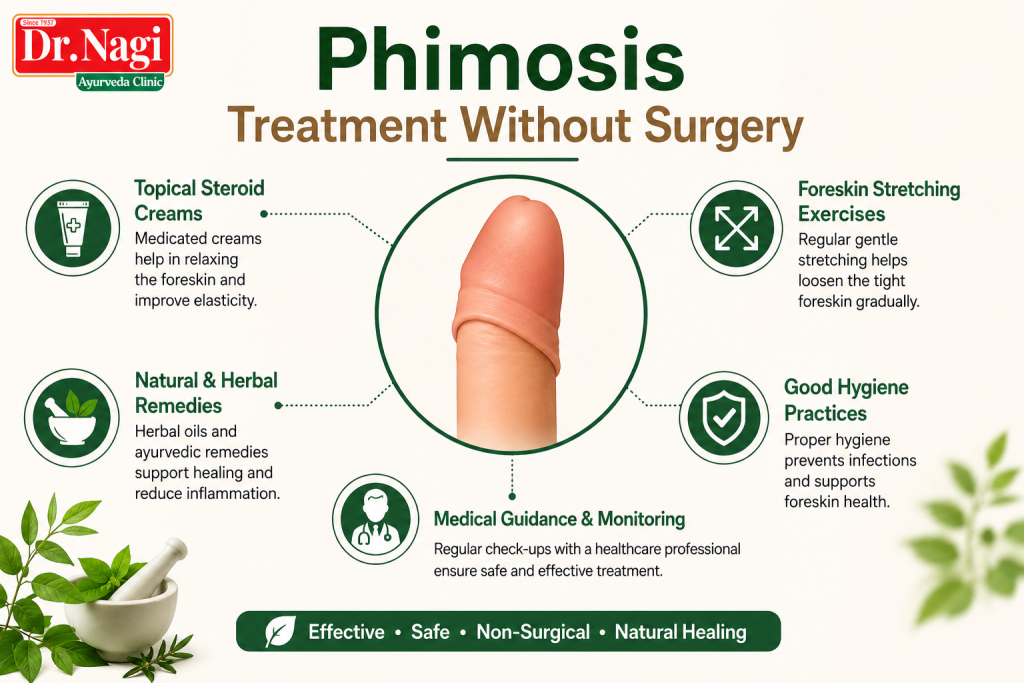
Phimosis Treatment Without Surgery: What’s Possible
For mild to moderate phimosis without significant scarring, non-surgical treatment is the recommended first approach, and it works in most suitable cases when done correctly.
Topical Steroid Cream
Betamethasone cream is the standard starting point. Applied once or twice daily for four to eight weeks, it reduces inflammation and softens foreskin tissue, improving elasticity.
Success rates range from 60–90% in appropriate cases, making it the preferred first step before any procedure.
Manual Stretching
Usually combined with cream, this involves gently widening the foreskin opening through repeated stretching over several weeks. Technique matters enormously, excessive force causes small tears that heal as scar tissue, actually narrowing the opening further.
Done gently and consistently, improvement is measurable. Done incorrectly, it worsens the condition and complicates further treatment.
Phimosis Home Treatment: The Ayurvedic Perspective
Ayurveda addresses phimosis by targeting its root causes, tissue quality, chronic inflammation, constitutional dryness, and internal imbalances, rather than treating tightness as a purely mechanical problem.
Medicated Oils
Externally applied oils formulated for tissue softening and inflammation reduction form the core of treatment. Oil selection is individualised based on constitution and the nature of tightness, not a one-size-fits-all approach.
Internal Herbs
Vata imbalance, linked to dryness and tissue constriction, is addressed through specific herbs prescribed internally to complement topical treatment.
Dietary Adjustment
Foods that worsen dryness or internal heat are identified and reduced through personalised dietary guidance.
Who It Suits
Best for mild to moderate cases without severe scarring, particularly those avoiding pharmaceuticals or where steroid cream has underdelivered.
Two to three months of consistent practice is the realistic assessment window. Consultation before starting is essential.

Phimosis Specialist: Why the Assessment Matters More Than the Treatment
A phimosis specialist who assesses the condition properly changes the outcome more than most men realise. Phimosis gets mismanaged in both directions, overtreated and undertreated, depending entirely on who is seen.
- Overtreating looks like recommending circumcision as the first response to every presentation regardless of grade. A man who comes in with grade two phimosis, no scarring, and no skin condition does not need surgery, he needs a proper non-surgical trial.
- Undertreating looks like dismissing the condition, offering vague guidance about hygiene, and sending the man away without any actual plan. This leaves the condition to worsen over time and the man no better informed than when he arrived.
A good phimosis specialist thoroughly assesses the condition, identifying lichen sclerosus, scarring, or inflammation, and exhausts conservative options before any surgical referral.
In India, conventional urology often leans toward aggressive intervention, making it important to seek practitioners who genuinely explore non-surgical alternatives first.
Phimosis Treatment Cost in India 2026
Phimosis treatment cost depends on the type of treatment, the city, the grade of phimosis being treated, along with whether the setting is government or private.
Approximate phimosis treatment cost ranges in 2026:
- Steroid cream course roughly Rs 200 to Rs 800 for the full prescribed duration
- Ayurvedic consultation and treatment course approximately Rs 1,500 to Rs 8,000 depending on duration and what is prescribed
- Preputioplasty phimosis treatment price generally falls between Rs 15,000 and Rs 40,000
- Conventional circumcision phimosis treatment price typically runs between Rs 20,000 and Rs 60,000
- Laser circumcision phimosis treatment price ranges from Rs 30,000 to Rs 80,000 in metro cities, somewhat lower in smaller cities
Government hospitals bring phimosis treatment costs down considerably. Private clinics offer faster access and more specialist choice at higher cost.
Phimosis treatment price at any facility should always be confirmed upfront and the confirmation should specify whether follow-up appointments, dressings, and post-procedure medication are included in the quoted figure or billed separately.
Recovery: What the Period After Treatment Actually Looks Like
Non-surgical phimosis treatment has no defined recovery period. Tissue elasticity builds gradually with daily cream application and stretching. Life continues normally throughout. There is nothing to recover from, only a process to maintain consistently.
Recovery after preputioplasty involves mild discomfort for five to ten days, careful wound hygiene, and no sexual activity for three to four weeks.
A follow-up appointment confirms healing is progressing as expected and gives the man clarity on when normal activity can resume.
Recovery after circumcision follows similar wound care across four to six weeks. Most men return to desk work within a week. Physically demanding work waits two to three weeks.
Sexual activity resumes at four to six weeks when the specialist confirms adequate healing. Aftercare during this window carries as much weight as the surgery itself.
Most complications that arise post-procedure, infection, delayed healing, prolonged discomfort, connect directly to aftercare that was not followed carefully.

About Dr. Nagi Clinic
Dr. Nagi Clinic in Ambala has been treating phimosis alongside other sexual health concerns since 1937.
The clinic handles phimosis as a medical condition, assessed individually, managed privately, and treated with Ayurvedic care oriented toward lasting resolution rather than the fastest available procedure.
The non-surgical and Ayurvedic treatment of phimosis is in the middle of the practice of the clinic, as well as the treatment of premature ejaculation, premature discharge, low stamina, low confidence and low desire.
Each patient is provided with a unique strategy based on his or her “What is phimosis meaning at different levels presentation and history. Privacy is maintained throughout without exception.
Dr. Nagi is recognised as one of the best Ayurvedic sexologists in India, a standing built through nearly nine decades of uninterrupted family clinical practice.
Patients visit from Ambala and surrounding areas including Yamunanagar, Patiala, Ludhiana, and Mandi Gobindgarh.
For men who prefer beginning with guided Ayurvedic support at home, Dr Nagi Clinic also provides Ayurvedic products focused on sexual and reproductive wellness.)
These are developed with the same clinical thinking behind the clinic’s in-person treatments and may serve as a practical starting point for men seeking structured Ayurvedic approach while arranging proper consultation.
Conclusion
The majority of guys who treat their phimosis properly never undergo surgery due to the fact that it is treatable. One honest meeting with a professional who takes a holistic, systematic approach is usually solution between silent suffering and finding a real solution.
This will be determined by proper evaluation and follow up, may be steroid cream or Ayurvedic remedy or surgery in case it is really needed. That is the step which most guys procrastinate the most and the one that really counts.
Frequently Asked Questions (FAQs)
When to See a Doctor?
When the foreskin is not fully retractable after adolescence, or painful during erections or sex, causes frequent infections, or appears thickened or white-scarred, consult an expert.
Can Phimosis Cause Erectile Problems?
Yes, directly. When a tight foreskin is used, it limits the natural stretch of the skin in the process of erection causing discomfort that is mild discomfort to acute pain.
Is Phimosis Dangerous If Left Untreated?
In mild cases, the risk is low but cumulative. Persistent inability to clean beneath the foreskin increases infection risk significantly.
What does phimosis treatment cost in India in 2026?
Non-surgical treatment costs a few hundred to several thousand rupees. Surgical options range from approximately Rs 15,000 to Rs 80,000 depending on the procedure and facility.
How long before returning to normal activity after surgery?
Desk work typically resumes within a week. Sexual activity is appropriate at four to six weeks when healing is confirmed by the treating specialist. The quality of aftercare during this period determines how smoothly recovery proceeds.